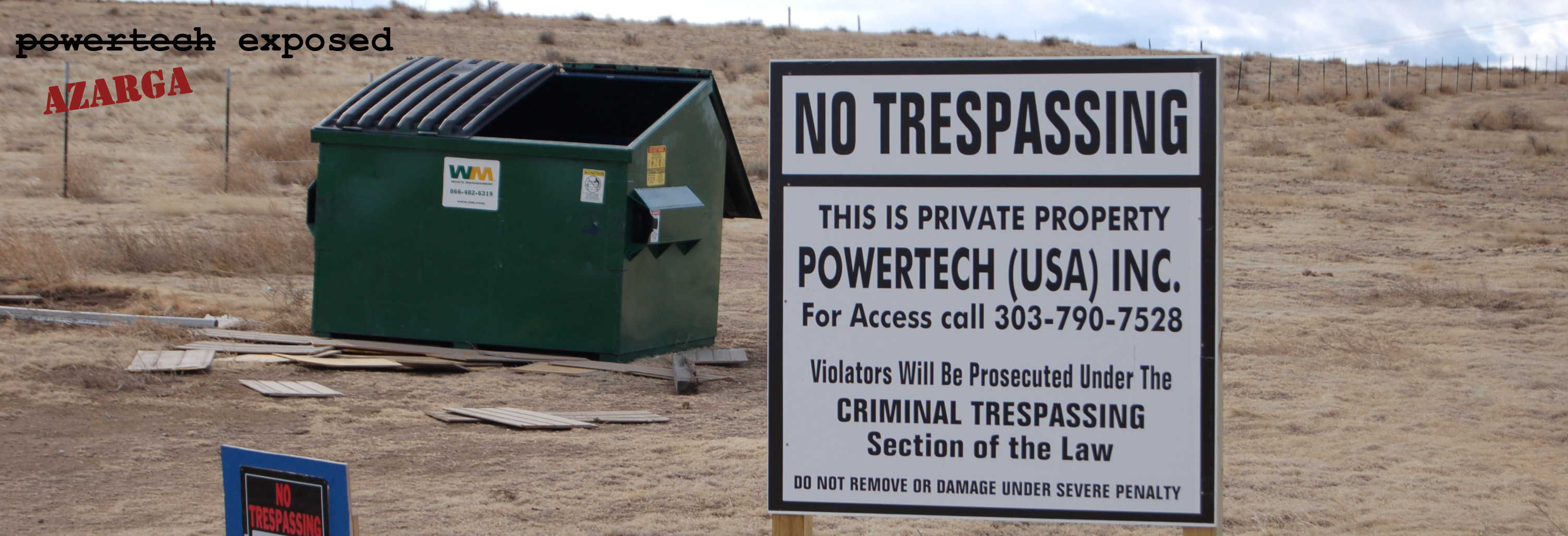
|
powertechexposed.com |
||||||||||||||||||||||||||||||||||||||||||||||||||
|
Information about proposed uranium mining in northern Colorado and Powertech Uranium Corp. |
||||||||||||||||||||||||||||||||||||||||||||||||||
|
Activists contest EPA actions on proposed mineBy JUDITH KOHLER Associated Press Writer Posted: 12/17/2009 02:18:24 PM MST DENVER—The Environmental Protection Agency is violating laws requiring public input by working behind closed doors to draft regulations for a proposed uranium mine in northern Colorado, activists said, citing agency documents obtained under the Freedom of Information Act. The EPA said Thursday it isn't violating any laws but is collecting information in anticipation of a permit application from Powertech USA, which wants to mine uranium using technology that injects a solution underground to dissolve and extract the mineral. Attorney Jeff Parsons of the Western Mining Action Project, which obtained the EPA documents, and Matt Garrington of Environment Colorado say any rules for so-called "in-situ" uranium mining should be devised publicly and on a national level. "It's a national precedent they're setting here," Parsons said. Many states have their own regulations for in-situ, or "in place," uranium mining. Colorado does not. Neither does South Dakota, where Powertech USA, based in suburban Denver, also wants to mine uranium. The regional EPA office in Denver, which oversees both states, acknowledges in e-mails between the agency and a Powertech consultant that any permits for the projects "will be the first nationally that EPA would issue and directly regulate under a direct implementation program." Agency spokesman Richard Mylott said that is why the EPA is talking to Powertech, state officials and others and collecting information about the site, near the town of Nunn, about 70 miles north of Denver. Mylott insisted the agency work is in anticipation of a permit application and that "no program policy, guidance or rulemaking" is under way. "If Powertech applies for a Class III permit, all relevant data and information will be fully disclosed for full review and comment by the public," Mylott said. A Class III permit allows injection of fluids in mining. But an Oct. 28, 2008, memo released as part of the FOIA documents says the regional office has developed "permit application guidance documents and policy statements regarding criteria and processes used for permit application review" and developing permit requirements. Powertech already has applied for an EPA permit to mine near Edgemont, S.D. It would need state permits and licenses and the approval from Nuclear Regulatory Commission as well to operate. Colorado residents are concerned about what the mine could do to groundwater quality in the quickly growing area. The Colorado Medical Society issued a resolution in 2007 opposing the mine because of possible health risks. "We can't allow this to be done behind closed doors," said Cory Carroll, a Fort Collins doctor who promoted the resolution. "Things that get accomplished there are not always in the best interest of the public." Richard Blubaugh, Powertech's vice president of environmental health and safety, insisted no decisions are being made in private. The company has been talking to the EPA for about two years, and Blubaugh said he is unaware of any rule drafting that would guide the process of obtaining a permit. "It's not about rules, it's about the interpretation of the rules," Blubaugh said of Powertech's meetings with the EPA. An Oct. 28, 2008, agency memo on the permit process conceded that federal regulations "tend to be very general and do not provide detailed information helpful to companies developing permit applications." Parsons agrees, noting current regulations were written in the 1980s. He said the problem is that the EPA appears to be fleshing out regulations while talking to Powertech, state officials and industry experts—in private. He pointed to an e-mail from Valois Shea, an official with the EPA's underground injection permit program, to a Powertech consultant as proof. In the April 14, 2008, e-mail, Shea said Powertech gets to be "the pioneering guinea pig that will make life easier for others following in your path." Parsons also said drafts of criteria the EPA could use to review mining sites address substantive issues. A June 6, 2008, draft includes descriptions of how to determine the area to be reviewed, and where groundwater would be affected. "It defines the scope of the EPA's review, the area they're going to take a look at to determine where to mine," Parsons said. "They've embarked on a substantive review and update of their regulations without public involvement." U.S. Sen. Mike Bennet and Rep. Betsy Markey, both Colorado Democrats, asked the regional EPA director in a letter last month to involve the public in any rulemaking because of concerns about mining and groundwater "near a population center of 300,000 people." "The public has raised serious concerns over contamination and they deserve to be heard in public forums," Markey said in a statement Thursday. EPA spokesman Mylott said the agency takes its commitment "to transparency seriously and will continue to do so." From: http://www.denverpost.com/search/ci_14019064 Nov 30, 2009 5:53 pm US/Mountain Lawmakers Want Public Input On Colorado Uranium MineJUDITH KOHLER, Associated Press Writer
Baseline plan: Not scientifically defensible Opponents blast deficient baseline characterization plan for Centennial uranium project; Geochemist says plan fails to use valid statistical methods and will not yield representative groundwater samples Posted November 22, 2009 REJECTED OR ACCEPTED? Powertech spins problems with Dewey-Burdock
Posted October 10, 2009
In the world according to Powertech, a permit application returned for incompleteness is not "rejected". But when such an application is redone, resubmitted, and found to be complete and ready for technical review, it is "accepted".
In June, the U.S. Nuclear Regulatory Commission gave Powertech an ultimatum: withdraw the company's application for an ISL mining license for the Dewey-Burdock project or the NRC would formally reject the application. Turns out, the 8,700-page application contained five material deficiencies that rendered it unsuitable for technical review by NRC staff. Powertech withdrew the application.
Two months later, the South Dakota Department of Environment and Natural Resources found Powertech's application for an Underground Injection Control Permit for the project to be incomplete and thus not ready for technical review. According to the 41-page letter to Powertech, three major issues were not adequately addressed in the application, and dozens of errors and deficiencies were noted.
In both of these cases, the permit applications were sent back to Powertech because they were determined to be incomplete. Neither agency could conduct a technical review of the applications. (An earlier application to the U.S. Environmental Protection Agency for an Underground Injection Control permit for the Dewey-Burdock project has been found to be complete.)
When Paul Robinson of the Southwest Research and Information Center was quoted as saying the applications had been "rejected as unacceptable", Powertech CEO Dick Clement was quick to respond. "The state did not reject our application...it's not unusual to get these kinds of questions" asserted Clement, referring to the incompleteness determination by the SDDENR.
In an earlier news release, Clement had already described the NRC's requirement to revise the federal permit application as a "voluntary withdrawal". Making every effort to obscure the fact that the company botched both permit applications, Powertech officials have downplayed the concerns of the permitting agencies and have been especially vehement in their denial that the applications have been rejected.
It is perhaps a fair criticism that the applications have not been "rejected". They have both been found "incomplete". In the words of the SDDENR:
So if they weren't "rejected", then a subsequent finding that a revised application is now "complete" shouldn't mean that it is "accepted", right?
Wrong.
On October 7, Powertech issued a news release with the following headline:
If you read the news release, you discover that the NRC has simply "found the Company’s application for its Dewey-Burdock uranium in situ project acceptable for detailed technical and environmental review." In other words, it is "complete". The news release goes on to make the misleading claim that the EPA has "accepted" the UIC permit application, which is currently undergoing technical review.
If Powertech officials were concerned about transparency and disclosure, they would say that a permit application has been "rejected for technical review" or "accepted for technical review", or that is has been "found to be incomplete" or "found to be complete".
JW
Mining project needs more objective reviewJohn S. Dixon Fort Collins Coloradoan October 4, 2009 This is in response to Wallace M. Mays' Soapbox article on Thursday regarding proposed uranium mining in nearby Weld County by Powertech (USA) Inc. Mays is chairman of the board at Powertech. Before Powertech begins mining and rolls the dice with our health and safety, our home values and our local economy, we must have a more objective appraisal of the proposed mining project. We need the appraisals of scientists who have doctorate degrees in the appropriate disciplines and who are independent of Powertech. Mays writes about the unintended movement of production fluids outside the mining zone and says "... excursions do happen ..." In other words, the methods Powertech intends to use to mine uranium cannot be relied upon to restrict the water used in the mining process to the mine site and cannot ensure that tainted extraction fluids will not contaminate nearby water supplies. Mays refers to a recent report published by the U.S. Nuclear Regulatory Commission. We need to read this report. We also need to read a recent U.S. Geological Survey report (Open-File Report 2009-1143), which concludes that no in situ leach mine in the United States has ever been able to return post-mining groundwater to its original, baseline condition. On July 8, at a town of Nunn public meeting, Mays said "... I don't do it (uranium mining) for the money ..." Considering Mays is a major stockholder in Powertech, this comment adds greatly to his credibility. RELATED DOCUMENTS:"Powertech works to protect health, safety" - Wallace M. Mays - Fort Collins Coloradoan - October 1, 2009DATA ON GROUNDWATER IMPACTS AT THE EXISTING ISR FACILITIES - (no author given) - U.S. Nuclear Regulatory Commission - (no date given) Note: This document was prepared by an unidentified NRC staff member(s) upon the request of the Commission. It is undated, authorship is unknown, and no sources are cited. It does mention that in the three mines reviewed (Irigary/Christensen Ranch in Wyoming, Smith Ranch/Highland in Wyoming, and Crow Butte in Nebraska), restoration efforts could only return 50-70 percent of constituents to baseline values. In particular, restoration of uranium, radium-226, arsenic, and selenium to baseline is often not attainable. The report also confirms that excursions of leaching fluids out of the mining zone have persisted for several years, and that leakage of well casings and fittings is not uncommon. The report concludes that "Potential environmental impacts to groundwater at an ISR facility can result from inadequate restoration of the production aquifer following completion of the ISR operations, leakage from a failure of the subsurface well materials, or an excursion of the leaching fluids to the aquifers surrounding the production or exempted aquifer." The report goes on to say that excursions and well failures "in most cases" do not pose a threat to the surrounding aquifers. (Apparently, in some cases they do.) Despite the numerous risks from ISL mining delineated in the report, the unnamed author repeatedly asserts that the NRC's regulation of these three mines has been successful at protecting "human health and the environment". This claim is made eleven times in the nine-page report, but there is no explanation of how these determinations were made, who made them, or the scientific criteria used to assess the various risks. "Groundwater Restoration at Uranium In-Situ Recovery Mines, South Texas Coastal Plain" - Susan Hall - Open-File Report 2009–1143, U.S. Department of the Interior, U.S. Geological Survey, Central Energy Resources Science Center - 2009 (PDF 3,236 KB)
Report by hydrogeologist finds Texas in-situ uranium mines have been unable to restore ground water aquifers to premining water quality - State regulators routinely approve leaving higher uranium levels in ground water; author questions mine operators' scientific understanding of aquifers - Posted October 24, 2008, Updated March 30, 2009
After in-situ uranium leaching, ground water cannot be returned to the way it was - Nuclear Regulatory Commission official and uranium mining executive acknowledge restoration of aquifer to baseline is unachievable - Posted September 3, 2008
See story on Wallace Mays' deal to sell uranium to the government of India U.S NUCLEAR REGULATORY COMMISSION:In-situ leach uranium mining affects groundwater quality when leaching solutions travel beyond well field boundariesRecent NRC document describes horizontal and vertical excursions at ISL mines in Wyoming and Nebraska, some lasting for as long as 8 yearsPosted September 13, 2009WHISTLEBLOWER: Former Texas ISL wellfield operator speaks outDid Powertech CEO Richard Clement's former employer violate environmental laws and endanger groundwater users? Posted September 8, 2009, Updated September 9, 2009 (Thanks to G. Harman and M. Krueger)
He claims also to have witnessed the falsification of monitoring-well data, which must be regularly submitted to the state to show the contaminated water is contained at the mine site. He tried unsuccessfully to get the TNRCC (now the Texas Commission on Environmental Quality) and FBI involved, and was fired in 1996. He moved a couple counties over, but now a URI offshoot wants to mine in his backyard, and he's decided to fight. Powertech CEO Richard Clement was an executive of Uranium Resources, Inc. for 16 years from 1983 to 1999. Watch the six minute video on YouTube. Read the story.NUNN TOWN BOARD VOTES TO OPPOSE CENTENNIAL PROJECTPosted September 3, 2009, Updated September 4, 2009On Thursday, September 3, the Town Board of Nunn, Colorado passed a resolution opposing Powertech Uranium Corp.'s proposed Centennial Uranium Project. The vote was four in favor, two opposed (including Mayor Jeff Pigue) and one abstention. Trustees Jenny Johnson, Karen Burd, Joyce Taylor, and Brian Jex supported the resolution.
Weld County residents Ken Tarbett and MIke Williams presented the resolution to the Town Board. Tarbett and his family get their water from a domestic well that is the closest well to the area Powertech seeks to mine first. The Tarbetts have yet to be contacted by Powertech.
The Mayor said he didn't understand the technical issues addressed by the resolution, and he raised the specter of angry mineral rights holders filing lawsuits against the town if the resolution were to pass. Town Trustee Joyce Taylor responded by asking why the cities and towns of Fort Collins, Greeley, Wellington, Ault, and Timnath had not been sued for the resolutions they had already passed against the project.
The Town of Nunn has no permitting authority with respect to the Centennial Project. However, it is the closest municipality to the proposed mine -- a portion of the proposed mining area is located within the town's 3-mile growth management area. The opposition to the project by the Town of Nunn and other municipalities will be an important consideration when the various permitting agencies weigh the environmental and socioeconomic impacts from the proposed project.
JW
Nunn digs in against uranium mine - Colin Lindenmayer, Greeley Tribune - September 4, 2009
Board opposes uranium mine - Bobby Magill, Fort Collins Coloradoan - September 4, 2009
WHEREAS, Powertech (USA) Inc.
(“Powertech”), a wholly-owned subsidiary of
WHEREAS, Powertech proposes to extract
the uranium using in-situ leach mining,
WHEREAS, leaching solutions
contaminated with heavy metals and radionuclides
WHEREAS, Powertech proposes to conduct
in-situ leach mining in the Laramie-Fox
WHEREAS, in-situ leach mining holds
inherent risks, including but not limited to the
WHEREAS, Powertech proposes to prevent
horizontal excursions of leaching solutions
WHEREAS, Powertech claims that
impermeable layers of rock will prevent vertical
WHEREAS, the proposed mining area
includes thousands of exploration drill holes from
WHEREAS, both vertical and horizontal
excursions of leaching solutions from the
WHEREAS, a lack of long-term
monitoring of aquifers at historical in-situ leach uranium
WHEREAS, land application of mine
wastewater could result in dispersal of
WHEREAS, wastewater holding ponds are
subject to leaks and failures as documented
WHEREAS, following the cessation of
in-situ leach uranium mining, Powertech would
WHEREAS, aquifer restoration involves
flushing the aquifer with large quantities of
WHEREAS, historical attempts to
restore aquifers to pre-mining baseline water quality
WHEREAS, the closest area to be mined
would be on Section 35, bounded by the Nunn
WHEREAS, the uranium deposits in the
area closest to the Town are shallow and
WHEREAS, shallow unsaturated uranium
deposits are typically extracted using open pit
WHEREAS, open pit mining holds
inherent risks, including but not limited to the
WHEREAS, Powertech originally notified
state mining regulators that it intended to
WHEREAS, Powertech has not reasonably
or fully explained how it intends to mine
WHEREAS, mineral estate owners have a
right to extract minerals when that extraction
WHEREAS, Powertech has been unable to
convincingly demonstrate that its proposed
WHEREAS, economic development is a
high priority for the Town; and
WHEREAS, uranium mining close to the
Town might provide employment for a few
WHEREAS, protection of health, safety,
and economic well-being is a primary
WHEREAS, for all these reasons the
Nunn Board of Trustees is strongly opposed to the
NOW, THEREFORE, BE IT RESOLVED BY THE
BOARD OF TRUSTEES OF THE
Section 1. The Nunn Board of Trustees
hereby strongly opposes the proposal for
Section 2. For all the foregoing
reasons the Nunn Board of Trustees further urges all Mining opponents pack Nunn meetingAugust 12, 2009By Steven OlsonThe Wellington (Wellington, Colorado's Community Newspaper)
They had to get extra chairs. Mayor Jeffrey Pigue, officers of the Nunn police department and others brought in 17 chairs to add to the 42 already in the room to seat the crowd that showed up for the Aug. 6 Nunn Town Board of Trustees meeting.
Facing a packed room, Pigue suggested that the more mundane items the board usually handles at the beginning of the meeting be moved to the end.
Interest was high because Powertech Uranium Corp., the Canadian-based firm that wants to mine uranium in Weld County between Nunn and Wellington (Colorado), had asked for an item of new business regarding its Centennial Project.
Area residents who monitor town board meetings were surprised to find Powertech on the agenda posted the day before the meeting, and details of the company’s request were not made available to the public. Town Clerk Tori McMechan would not provide an advance copy of the proposed resolution to The Wellington, saying that she might be in violation of attorney-client privilege if she did so.
Read aloud at the town board meeting, the resolution stated Powertech wanted to work with Nunn to iron out any problems connected with the Centennial Project and to establish a cooperative relationship with the town.
The audience, which consisted of a mixed group including members of Coloradoans Against Resource Destruction, citizens of Nunn and people who live nearby, wasted no time in expressing an opinion on accepting the letter. It was a unified and very loud “No.”
Trustee Brian Jex got a loud burst of applause when he observed, “If we adopt this, we’re showing we’re pro-Powertech, which I’m against to be honest with you.”
The board agreed to table the matter. While most in the audience applauded, some, like longtime Nunn resident Alvarita Thomas, wanted to know what that meant. Pigue responded, “It’s a dead issue now.”
Many were filing out of the board meeting room when Thomas persisted, “I’m concerned that when you say it’s a dead issue, it might rise from the grave.”
“It’s dead as far as this meeting is concerned,” Pigue said. “…Until someone brings it up again, it’s dead. If someone brings it up later, we have no choice but to hear it.”
Though Pigue said the issue was dead, there were some in the audience and some milling about outside the small community center who were still suspicious. Dog breeder Gerrit Voshel, a CARD member who lives on Weld County Road 17 near one of the proposed mining sites, said the entire situation “sounded like a lot of smoke and mirrors.”
“They tried to slip something past us at the last minute,” said Voshel, “but thanks to e-mail and the Internet we can get a crowd together pretty quickly.”
POWERTECH DRILLING CREW LEAVES OPEN BOREHOLE, VIOLATES STATE WATER LAW Open hole discovered on May 1, 2009 by inspector from Colorado Division of Reclamation, Mining and Safety; inspection report released two months later Posted July 6, 2009 Antelope Hill Blog
June 14, 2009 - The U.S. Nuclear Regulatory Commission has identified five material deficiencies in Powertech's application for a license to conduct in-situ leach uranium mining at its Dewey-Burdock project near Edgemont, South Dakota.
Powertech submitted the license application on February 25, 2009, and NRC staff conducted an acceptance review that ended with a May 26 phone conference with Powertech informing the company of the problems.
According to an NRC notice, the material deficiencies in Powertech's application relate to hydrogeology/site characterization, waste disposal, well field locations and layout, protection of water resources, and operations information.
In a
May 28 letter to the NRC,
Powertech Vice-President Richard Blubaugh stated that "While Powertech
may not fully agree with NRC Staff's conclusions regarding the
(According to NRC document NUREG-1569, "The applicant’s....failure to supply information requested by the staff to complete the review (10 CFR 2.108) is also grounds for denial of the application.")
NRC staff and Powertech attorneys and officials including Chairman Wallace Mays met on June 11 to discuss the problems with the application. Interested members of the public participated in the meeting via teleconference.
According to a participant and related news coverage, the meeting concluded with NRC staff declaring that the application was incomplete, and that if Powertech did not withdraw the application the NRC would send a rejection letter. Powertech is expected to respond in a week or two.
The problems with the application are numerous, and will likely take some time to correct. According to a participant who monitored the meeting, the deficiencies include:
The meeting participant said Powertech cited the high cost of exploration drilling and testing as a reason why additional information was not provided to the NRC.
Correcting the application's deficiencies will delay permitting of the project. Powertech has made permitting of Dewey-Burdock its number one priority after last year's passage of House Bill 08-1161 by the Colorado legislature and subsequent rulemaking delayed the submittal of permit applications for the Centennial project in northern Colorado. In addition, Powertech has so far been unable to obtain approvals for a final aquifer pump test needed to collect data for its Colorado and EPA applications.
Presumably, Powertech has been counting on progress with its Dewey-Burdock permit applications to convince investors to provide more venture capital. Since the company has yet to file its March 31 fiscal year-end financial statements with Canadian securities regulators, its cash position is unclear. The NRC's non-acceptance of Powertech's application for Dewey Burdock will undoubtedly be seen as bad news by investors.
JW Why I created powertechexposed.com
This site is dedicated to uncovering the facts surrounding Powertech Uranium Corp.'s proposal to mine uranium in Weld County, Colorado. Furthermore, its purpose is to protect the health, environment, property, and livelihoods of residents, landowners, and business owners by petitioning elected officials and government agencies on this matter of heightened public concern. My family and I live on the prairie between the towns of Wellington and Nunn, Colorado. Our land is about two miles west of the area that Powertech wants to mine. Our water, and all our neighbors' water, comes from wells drilled into the Laramie-Fox Hills aquifer. After reviewing the history of uranium mining by the in situ leach and open pit methods, my opinion is that this project would likely contaminate the groundwater aquifer used by hundreds of well owners, disperse windblown radioactive dust over the Fort Collins/Wellington/Nunn/Ault area, and negatively impact the real estate market and general economic prosperity of this part of northern Colorado. Powertech proposes to mine on at least twelve sections of land, roughly 7,000 acres, located between the City of Fort Collins and the towns of Wellington, Nunn, and Ault. One of the mining areas is six miles from the city limits of Fort Collins, and much of the mining area is located within the proposed growth management area of the town of Nunn. The proposed project is generally referred to as the Centennial Project. In fact, it is two projects: The "Indian Springs" project consists of the seven northern sections where in situ leach mining is proposed. The "Centennial" project includes the five southern sections of land slated for sand and gravel mining followed by conventional open-pit uranium mining. At the July 19, 2007 open house in Nunn, Powertech representatives suggested the company is considering an untested alternative to open-pit mining on the southern sections - flooding the area to saturate the shallow uranium deposits, followed by "modified" in situ leaching. Powertech officials admit that this flooding process has never been attempted. The Canadian corporation, incorporated in 1984 as Ararat Oil & Minerals Inc., has for most of its existence been a manufacturer of boilers and water heaters. In May 2006, control of the publicly-traded shell corporation was transferred to the current goup of managers who announced that the company was now in the uranium mining business. However, Powertech has never mined uranium, has never realized revenue from mining uranium, and has never obtained a permit to conduct uranium mining. It has, however, raised more than $23 million in Europe and Canada by promoting and selling penny stock to investors. The promotion of Powertech has been orchestrated from its head office in Centennial, Colorado and its corporate office in Vancouver, British Columbia. The Vancouver address has been shared by at least six other Canadian penny stock firms in the recent past. Thanks to the friends, neighbors, public officials, anonymous sources, Powertech employees and contractors, and others who provide inspiration, ideas, and content for this site - your contributions are greatly appreciated.
Jim Woodward Wellington, Colorado, USA
|
Site updated February 7, 2010 Can't find the information or document you're looking for? Try our search engine: Documents ● Maps ● Postings ● News Stories ● www.townofnunn.net ● Editorials & Letters ● Research tools ● House Bill 1161 ● Photos ● Mine Proximity ● Graphics ● Quotes ● CARD ● Scorecard ● Uranium, radium & radiation ● Links ● Contact us
Will the Belgians throw good money after bad? (Apparently so.) On June 4, 2008, Belgian firm Synatom invested $9 million CAD in Powertech Uranium Corp. Six million shares of stock were issued to Synatom at $1.50 CAD per share. The value of these shares has dropped to $2.22 million CAD as of December 4, 2009. Synatom's investment has fallen 75% for an unrealized loss of $6.78 million CAD.
See story: Powertech sells off part of company to European multinational corporation - Canadian firm to get $9 million cash injection from Societe Belge De Combustibles Nucleaires Synatom SA, a subsidiary of Electrabel/SUEZ Group Posted June 3, 2008 When uranium mining goes wrong Is this the future of northwestern Weld County?
Source: http://www.epa.gov/region09/waste/sfund/navajo-nation/contaminated-water.html
The No Uranium Song - written and performed by Russ Hopkins. Order your CD here. Download an MP3 for $1.00 here. All proceeds to benefit C.A.R.D. in the fight against uranium mining in northern Colorado. Note to Powertech's attorneys: The First Amendment to the US Constitution: Congress shall make no law respecting an establishment of religion, or prohibiting the free exercise thereof; or abridging the freedom of speech, or of the press; or the right of the people peaceably to assemble, and to petition the government for a redress of grievances.
|
|||||||||||||||||||||||||||||||||||||||||||||||||